
Play krillion unlimited free — the endless dive trivia game
krillion unlimited is FreeKrillion's endless mode: dive after dive with no daily limit, no account, and no cost. Each dive hands you seven open-ended prompts — "name a band," "name a river" — and gives you twenty-five seconds per prompt to type the single answer you think fewest other people would give.
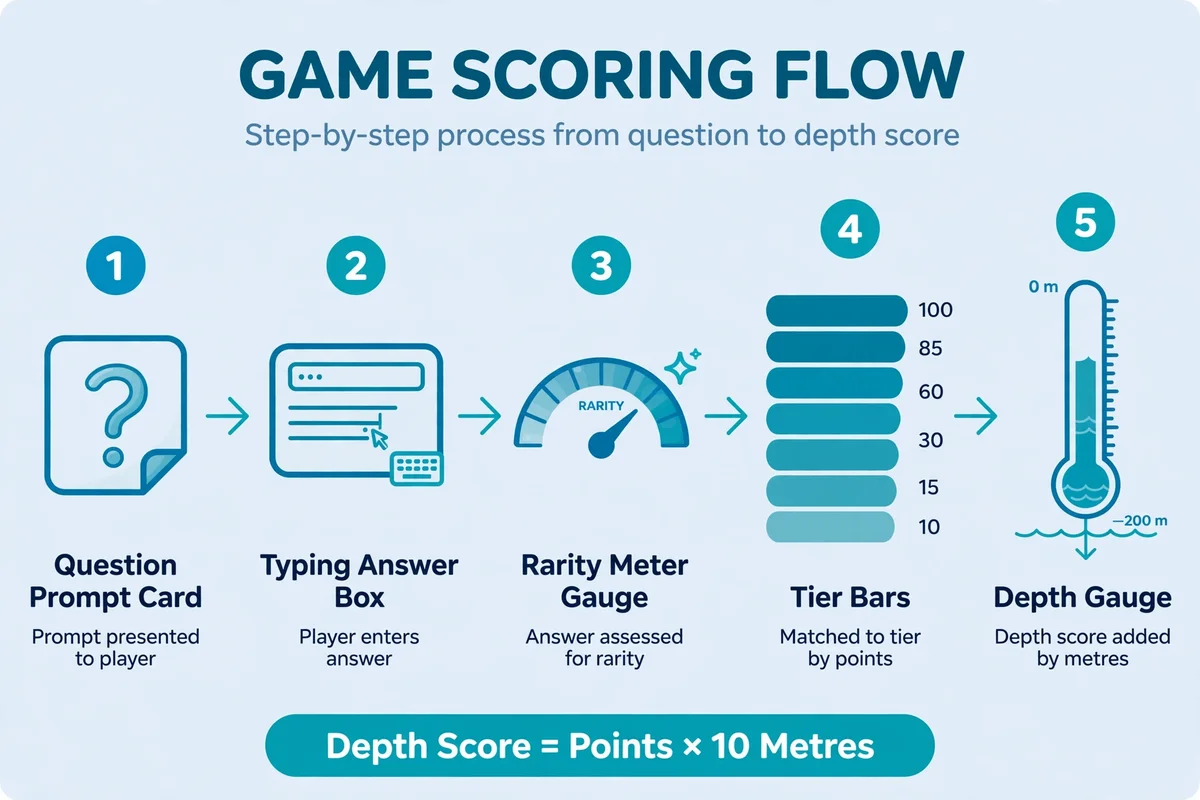
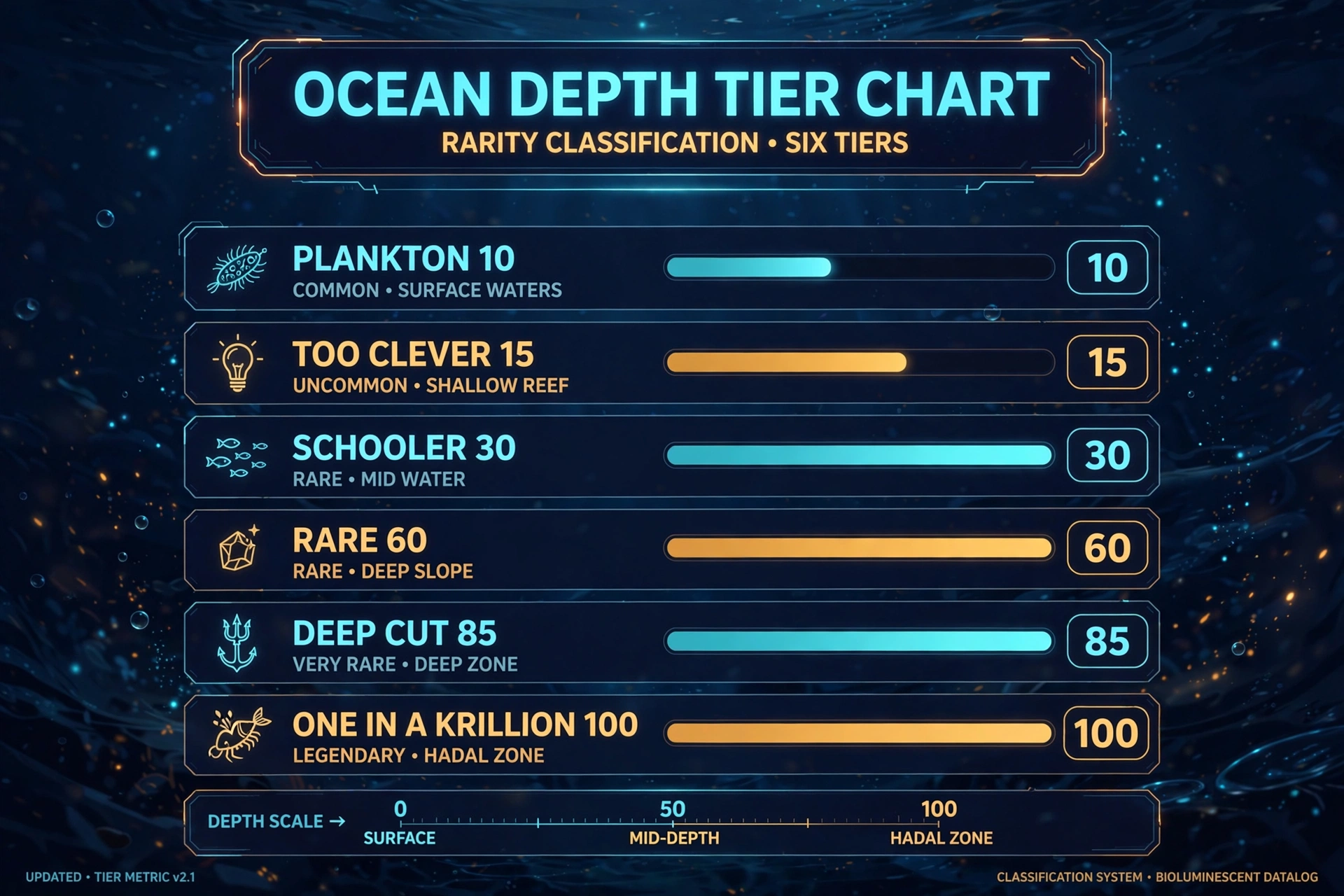
That twist is the whole game. Most quizzes reward what you know; FreeKrillion rewards what you know that other people don't. Every answer lands on a six-rung rarity ladder — Plankton (10), Too Clever (15), Schooler (30), Rare (60), Deep Cut (85), One in a Krillion (100) — and every point sinks you ten metres. A flawless dive ends at 7,000 metres on the trench floor.
How a dive feels
The clock starts, the prompt lands, and your brain does something unusual: it stops reaching for the obvious. "The Beatles" will score — but barely. Some half-remembered B-side band might take you to the midnight zone in one answer. Small typos are forgiven automatically, and if the depths don't recognize your answer you get a poetic "no echo" while the clock keeps running, so you can try again.
After each answer the depth odometer ticks upward metre by metre, the zone banner shifts — sunlit shallows, twilight edge, midnight zone, abyssal plain, hadal trench — and your krill companion reacts. Nothing is ever revealed: FreeKrillion never shows answer lists, so every dive stays a mystery you navigate by instinct.
The six tiers, from drifters to legends
Every accepted answer lands on one of six rungs, and each rung has a personality. Plankton (10 points) is where the obvious answers drift — the first thing everyone thinks of. There is no shame in plankton; it still sinks you 100 metres, and a full dive of plankton still reaches 700 metres, deeper than any scuba diver has ever gone. The recreational scuba limit sits around 40 metres, and the deepest experimental dives barely passed 300 — so even the shallowest krillion dive out-descends human lungs.
Too Clever (15) catches the answers that tried to dodge the obvious and only half-succeeded — the second-most-famous band, the river everyone learned in school but nobody names first. Schooler (30) is solid, respectable obscurity: real knowledge, just not the knowledge everyone reaches for. This is where most thoughtful divers live, and a steady diet of Schooler answers carries you comfortably past 1,000 metres into true midnight water.
Rare (60) is where the water gets interesting — genuine obscurity, the kind of answer that makes the scoring engine pause. A single Rare answer sinks you 600 metres, past the twilight edge in one plunge. Deep Cut (85) is the answer almost nobody has: the B-side, the tributary, the third-string constellation. Landing here feels like striking a vein of something precious. And One in a Krillion (100) — the mythical tier, the answer so perfectly rare it scores the maximum. Seven of these in one dive is the perfect 700: the full 7,000-metre descent, a feat most divers will chase for months before they ever touch it.
How rarity scoring actually works
Behind every prompt sits a bank of accepted answers — dozens per question, each pre-scored by rarity. When you type, the engine doesn't demand perfection: small typos are forgiven automatically through fuzzy matching, so a slip of the finger won't cost you the depths. What the engine never does is show you the bank. No answer lists, no correct reveals, not even after the dive ends. You learn your tier and your depth, and the rest stays mystery.
This secrecy is deliberate, and it's the load-bearing wall of the whole design. The moment answer lists go public, everyone studies them, the rare answers become common knowledge, and rarity dies. The mystery is the game — it forces every diver to navigate by instinct rather than memorization. If your answer isn't recognized at all, you get a poetic "no echo" and the clock keeps running: a second chance to dredge up something the depths know.
Five zones, 7,000 metres of ocean
Your score isn't a number — it's a place. Every point sinks you ten metres through a real ocean, zone by zone. The Sunlit Shallows (0–200m) are warm, bright, and crowded: coral reefs, darting schools of fish, everything visible. Most first answers land here, and there's nothing wrong with that — the shallows are where every dive begins.
Cross 200 metres and you enter the Twilight Edge (200–1,000m), where sunlight fades to a blue gloom and the water turns the color of deep thought. This is where clever answers start separating from obvious ones. At 1,000 metres the Midnight Zone (1,000–4,000m) begins: no sunlight at all, only bioluminescence. Anglerfish drift with their lanterns, sperm whales hunt giant squid in the black, and at 3,800 metres you drift past where the Titanic rests — a real shipwreck on a great dive's itinerary.
Below that, the Abyssal Plain (4,000–6,000m) — near-freezing, crushing pressure, a desert of fine sediment where only the rarest answers venture. And finally the Hadal Trench (6,000–7,000m), named for Hades himself: the deepest places on Earth. In the real ocean, the Mariana Trench's Challenger Deep plunges nearly 11,000 metres — only a handful of humans have ever been there. Our trench floor sits at 7,000, reachable only by a near-perfect dive.
Why unlimited?
The daily dive gives everyone the same seven prompts once per day — perfect for ritual. Unlimited mode is where you train: learn which corners of your memory run deep, build rarity instincts, and chase a personal best without waiting for tomorrow. Your dives save per mode, so you can leave mid-dive and surface exactly where you left off.
Strategy: think like the crowd, then step sideways
The core skill isn't knowledge — it's metacognition, thinking about thinking. When a prompt lands, your brain serves up the most accessible answer first. That answer is plankton, by definition: if it came easily to you, it came easily to everyone. The move is to acknowledge it, set it aside, and ask: what's the second answer? The second answer is where Schooler and Rare live — the response that required one extra moment of thought, the one your brain offered only after the obvious candidate was dismissed.
Category matters too. Some categories have deep benches — "name a river" has thousands of real answers, from the Amazon to the Mekong to the Dnieper, so rarity rewards the well-traveled mind. Others are shallow by nature; there are only so many ways to answer "name a planet in our solar system." Learn which of your mental shelves are stocked: the diver who knows obscure prog-rock bands but only famous rivers should lean into music prompts and play rivers safe. Over dozens of dives, you'll map your own cognitive coastline — and the deep water will start feeling like home.
And respect the clock. Twenty-five seconds is generous until it isn't — a timed-out prompt scores zero, while even a plankton answer banks 100 metres. When the timer bleeds under five seconds, type something. A shallow answer beats a drowned one, and the depths reward the decisive.
Not another trivia game
Pub quizzes reward the person who knows the most. Game shows reward the fastest buzzer. Multiple-choice tests reward elimination. Krillion inverts all of it: the question isn't what you know, but what you know that others don't. It's a game about the shape of collective memory — the strange topography of what everyone knows versus what almost no one does. Two divers can both be right about "name a planet" and score tiers apart, because one said Mars and the other said Kepler-186f.
That inversion changes how your brain works during play. You stop reaching outward for facts and start reaching inward, past the obvious, into the dusty corners where your rarest knowledge lives. It's less a test than an excavation — and every dive teaches you something about how your own mind is organized, which answers surface first and which ones you have to dive for.
Four ways to dive
Unlimited mode is the endless training ground, but it's one of four waters. The daily dive gives every diver on Earth the same seven prompts once per day — a shared ritual, one scored attempt, the purest measure of rarity instinct. Practice mode is zero-pressure water for learning the ropes before your real dives, auto-starting so you can warm up in seconds. And multiplayer brings witnesses: pass-and-play on one device, or online rooms where divers descend simultaneously and the live leaderboard decides the winner. Each mode saves separately, so your daily ritual, your training, and your rivalries never interfere with each other.
The question bank
Every dive draws from a bank of 172 hand-built questions, each stocked with dozens of accepted answers — the average question recognizes nearly 70 valid responses, and the deepest ones hold close to 200. The bank is built for rarity: questions are chosen not for trickiness but for answer breadth, the number of genuinely different correct responses a prompt can produce. "Name a bird" is a better krillion question than "what's the capital of France" — not because it's harder, but because its answer space is an ocean while the other's is a puddle. New questions join the bank over time, and signed-in divers can suggest their own for review.
Free, forever
FreeKrillion costs nothing and shows no ads. Guests play every mode in full; signing in with Google only unlocks permanent cross-device stats and online multiplayer rooms. Your first sign-in sets a permanent diver name — one diver, one name, forever.
There is no premium tier, no energy system, no pay-to-descend. The ocean is open water: every prompt, every tier, every metre of the 7,000 is available to every diver from the first dive. That's the point — rarity can't be bought, only found.
Frequently asked questions
Is FreeKrillion really free?
Yes. No payments, no ads, no premium tier. Every mode — Daily, Unlimited, Practice and Multiplayer — is fully playable at no cost.
Do I need an account to play?
No. You can dive straight in as a guest. An account is only needed if you want permanent stats or online multiplayer — your first Google sign-in sets a permanent diver name.
How does scoring work?
Each dive has 7 prompts and you get 25 seconds per prompt. Answers are scored by rarity across six tiers: Plankton (10), Too Clever (15), Schooler (30), Rare (60), Deep Cut (85) and One in a Krillion (100). The rarer your answer, the more points.
What does depth have to do with points?
Every point sinks you 10 metres. A perfect 700-point dive reaches 7,000 metres — the trench floor. Your depth meter is your score, visualized as a real ocean descent.
What is a dive?
A dive is one full game: 7 prompts, 25 seconds each. The Daily dive gives everyone the same 7 prompts once per day; Unlimited lets you dive again and again.
Are the correct answers ever shown?
Never. FreeKrillion never reveals answer lists — your result shows how your own answer scored, and the mystery is part of the game.